
+86 138-8985-0231/+86 138-9812-5732

AEO-9 is a nonionic surfactant commonly used in industrial formulations that require wetting, emulsification, detergency or compatibility with other surfactants.
During formulation work, one phenomenon often causes confusion:
A solution that appears clear at one temperature may become hazy or cloudy after heating.
After cooling, the solution may become clear again.
For users who are unfamiliar with nonionic surfactant behavior, this can raise several questions:
In many cases, this behavior is related to the cloud point of nonionic surfactants containing polyoxyethylene chains.
Cloud point is not simply a visual appearance issue. It reflects changes in the interaction between the surfactant molecule and water as temperature changes.
Understanding this behavior is useful for formulation development, raw-material comparison and production troubleshooting.
AEO-9 belongs to the fatty alcohol ethoxylate family.
These materials are generally produced by reacting fatty alcohols with ethylene oxide.
The molecule contains two main parts:
The balance between these two parts determines many of the surfactant's properties.
AEO-9 typically contains a greater degree of ethoxylation than lower-EO products such as AEO-3.
This usually gives AEO-9 greater affinity for water than lower-EO fatty alcohol ethoxylates.
However, water compatibility does not mean that its behavior remains unchanged at every temperature.
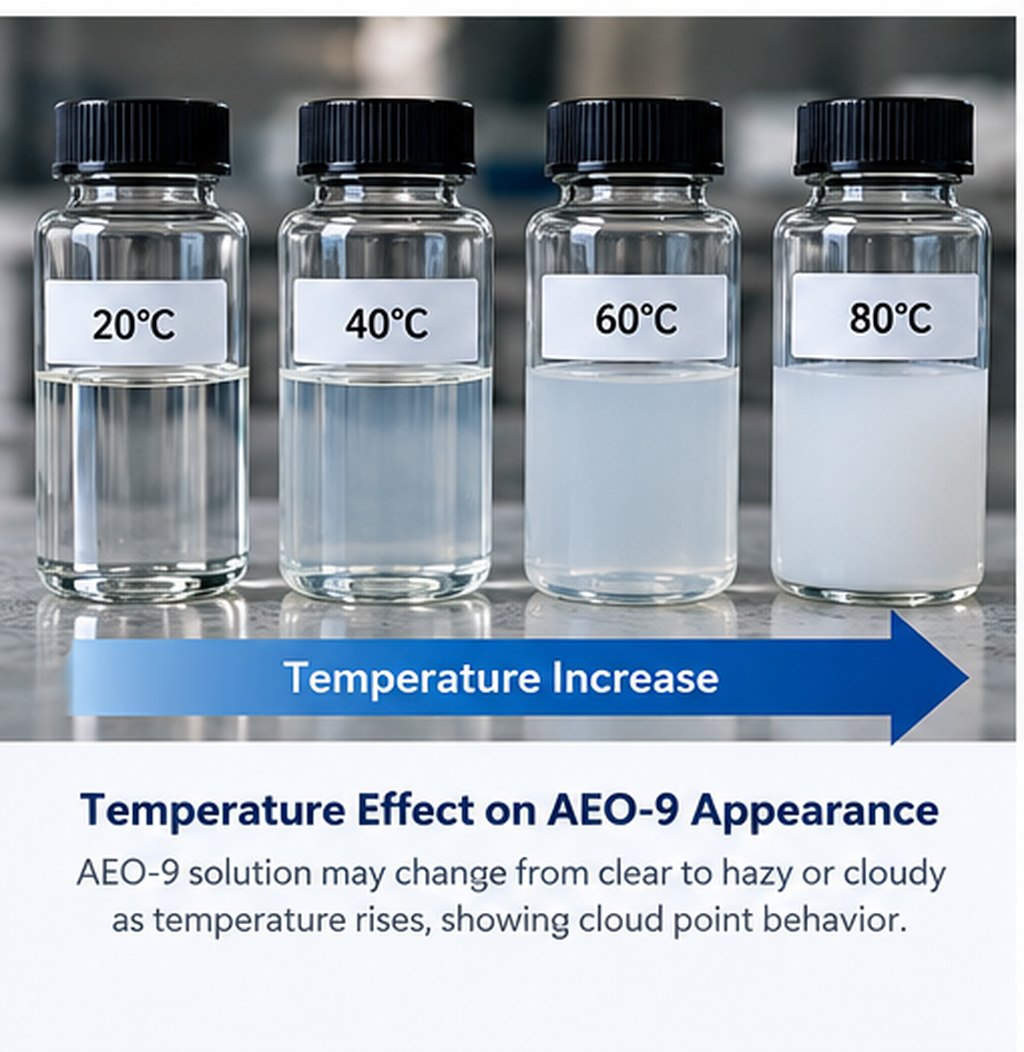
The cloud point is the temperature region where an aqueous solution of certain nonionic surfactants begins to lose optical clarity.
Below this temperature, the surfactant may remain well hydrated and dispersed in water.
As temperature rises, the interaction between the polyoxyethylene chain and water gradually changes.
At a certain stage, surfactant-rich structures begin to associate more strongly.
The solution may then appear:
The exact appearance depends on concentration, formulation and test conditions.
This behavior may seem unusual because many materials become more soluble when heated.
Polyoxyethylene-type nonionic surfactants can behave differently.
Their hydrophilic polyoxyethylene chains interact with water through hydration.
As temperature increases, the degree of hydration can decrease.
When the ethoxylated portion becomes less strongly associated with water, the relative influence of the hydrophobic portion becomes greater.
Surfactant molecules may then associate into larger structures.
As these structures become large enough to scatter light, the liquid begins to look cloudy.
This is the basic reason cloud point behavior is associated with temperature.
Not necessarily.
If the cloudiness appears near the surfactant's normal clouding region and disappears after cooling, it may be a reversible physical phenomenon.
That is different from chemical degradation.
Chemical degradation may involve changes that do not reverse simply by lowering temperature.
For troubleshooting, it is useful to observe:
This helps distinguish reversible cloud-point behavior from other stability problems.
The number of ethylene oxide units influences the hydrophilic character of the molecule.
In general, a higher ethoxylation degree gives a fatty alcohol ethoxylate greater affinity for water.
This is one reason AEO-3 and AEO-9 can behave differently.
AEO-3 contains fewer ethylene oxide units and is relatively more hydrophobic.
AEO-9 contains a longer ethoxylated chain and is generally more compatible with aqueous systems.
However, the actual clouding behavior still depends on:
Therefore, the product name alone does not define the complete behavior.
“AEO-9” describes a general ethoxylation category, but commercial products are not necessarily composed of one single molecular species.
Actual products may contain a distribution of molecules with different:
Manufacturing conditions may also influence the distribution.
As a result, two products both sold as AEO-9 may show differences in:
This is why supplier replacement should be confirmed in the customer's actual formulation.
Cloud point is not always independent of surfactant concentration.
If one laboratory tests a low-concentration AEO-9 solution and another tests a more concentrated solution, the observed clouding temperature may differ.
Therefore, when comparing cloud point data, the test conditions should be consistent.
Important information includes:
Without these details, two cloud-point values may not be directly comparable.
Cloud point is a measured property.
Like many surfactant properties, the result depends on how the test is performed.
Possible differences include:
One technician may record the first appearance of haze.
Another may record the temperature when the solution becomes clearly opaque.
These two approaches can produce different reported values.
For supplier comparison, the same test method should be used for all samples.
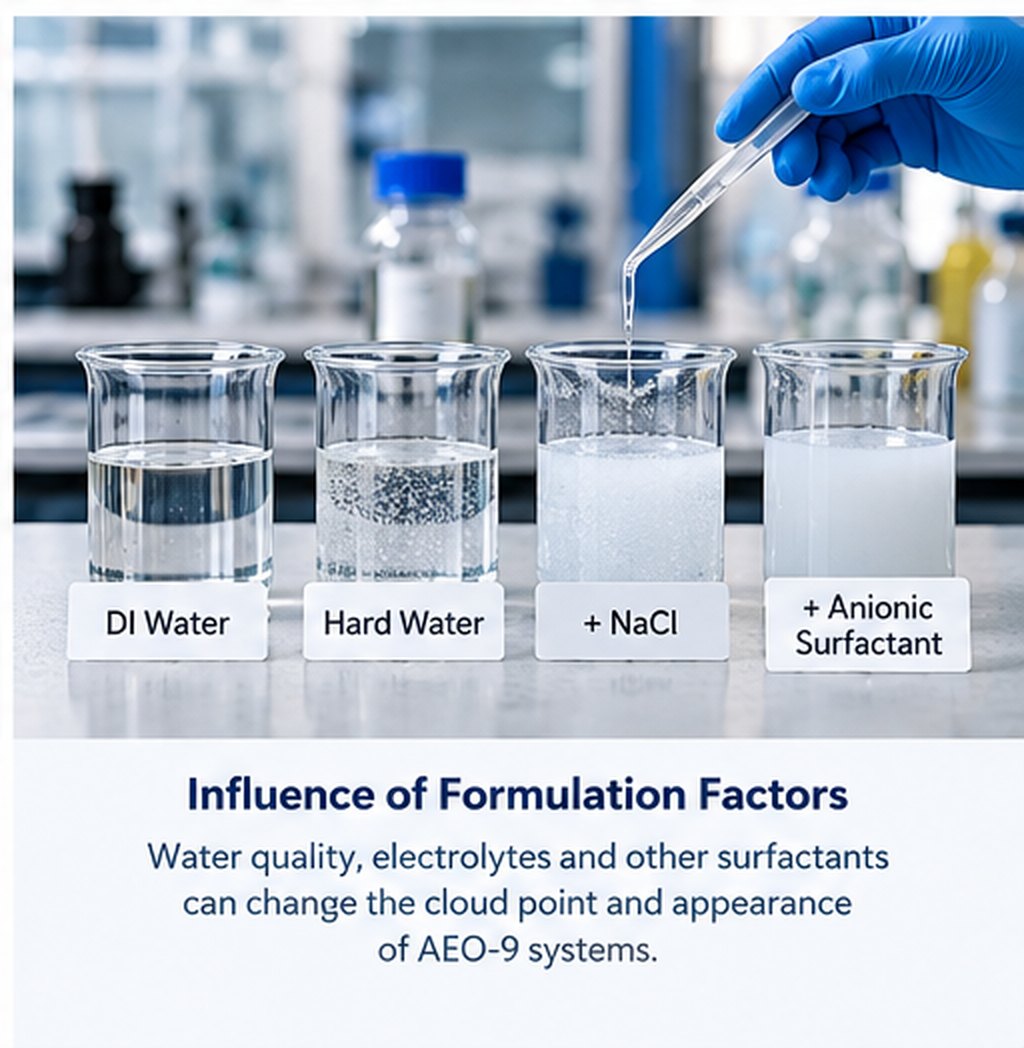
Water is not always chemically identical.
Different water sources may contain different concentrations of:
These ions can influence surfactant solution behavior.
As a result, AEO-9 prepared with deionized water may behave differently from AEO-9 prepared with:
If a formulation changes appearance after moving from laboratory to production, water quality should be included in the investigation.
Because AEO-9 is nonionic, it generally behaves differently from strongly ionic surfactants in the presence of water hardness.
However, this does not mean hardness has no effect on the complete formulation.
Calcium and magnesium may interact with:
This can indirectly change:
Therefore, raw AEO-9 behavior and finished-formulation behavior should be evaluated separately.
Electrolytes can change the hydration environment around the polyoxyethylene chain.
When salts are added to a formulation, the cloud point may shift.
The extent of the change depends on:
This is especially relevant in formulations that contain:
A formulation that is clear before salt addition may become hazy after the electrolyte level is increased.
Suppose an AEO-9-containing formulation is clear during the initial mixing stage.
The formulator then adds an electrolyte to modify:
After addition, cloudiness appears.
It may be tempting to conclude that the AEO-9 batch is defective.
But the change may actually result from the new formulation environment.
A controlled test can help confirm this:
This makes it easier to identify whether the electrolyte is the main factor.
Yes, mixed surfactant systems can behave differently from single-surfactant solutions.
AEO-9 may be combined with materials such as:
Mixed micelles and interactions between surfactant species can alter:
Therefore, the cloud point of pure AEO-9 should not automatically be treated as the cloud point of the finished mixed formulation.
Industrial cleaning formulations may contain more than one nonionic surfactant.
For example, a formulator may combine different alcohol ethoxylates to adjust:
The resulting mixture may have different phase behavior from either raw material alone.
This is one reason finished formulations should be tested across the actual expected temperature range.
The main structural difference is the ethoxylation level.
AEO-3 has a shorter polyoxyethylene chain and a more hydrophobic balance.
AEO-9 has a longer ethoxylated portion and greater water affinity.
Therefore, they may differ in:
They should not be treated as direct substitutes simply because they belong to the same fatty alcohol ethoxylate family.
They can be evaluated together in formulation development.
A blend may be used when the formulator wants to adjust the hydrophilic-lipophilic balance of the surfactant system.
However, the final behavior depends on:
The appropriate ratio should therefore be determined experimentally rather than copied directly from another formulation.
An industrial cleaning product may experience very different temperatures during:
A formulation that remains clear at room temperature may become cloudy in a heated process.
Another product may change appearance during low-temperature storage because of other components.
Therefore, formulation testing should consider the temperature range that the product may actually encounter.
Not necessarily.
Whether clarity is required depends on the product design.
For some industrial products, temporary clouding may not interfere with use.
For other products, visual clarity may be part of the customer's specification.
For example, a transparent liquid detergent may have stricter appearance requirements than an opaque industrial degreaser.
Therefore, “clear” or “cloudy” should be evaluated against the intended application rather than treated as a universal quality judgment.
Some cleaning and industrial formulations contain water-miscible or partially water-miscible solvents.
Solvents can change:
Depending on the solvent and concentration, the formulation may become:
Therefore, when replacing a solvent or changing its dosage, the surfactant system should be re-evaluated.
AEO-9 itself is nonionic, so its behavior is not controlled by ionization in the same way as anionic or cationic surfactants.
However, pH can still influence other components in a formulation.
For example, changing pH may alter:
These changes can indirectly affect the appearance and stability of an AEO-9-containing formula.
Not all phase changes happen immediately.
After mixing, a formulation may require time to reach equilibrium.
Slow changes can involve:
Therefore, formulation evaluation should not rely only on appearance immediately after mixing.
It may be useful to observe samples after:
A heating-cooling test can help identify whether a formulation undergoes reversible changes.
A simple development test may involve:
Additional cycles may be used to evaluate repeatability.
This does not replace a formal stability program, but it can help during early formulation development.
Suppose a formula becomes cloudy.
If the formulator simultaneously changes:
and the problem disappears, it becomes difficult to know which change solved it.
A more useful method is:
change one variable → test → record → compare.
For example:
First adjust electrolyte concentration.
Then evaluate AEO-9 concentration.
Then test solvent level.
This produces more useful development data.
A supplier comparison should use the same test conditions.
Keep constant:
Then compare:
This allows the formulator to evaluate whether the new product behaves similarly in the real system.
Cloud point is one technical property.
But AEO-9 may be selected for functions including:
A product with a suitable cloud point should still be evaluated for the primary performance target.
For example, two samples may show similar clouding temperatures but different wetting behavior.
Therefore, selection should combine physical-property data with application testing.
Depending on the customer's internal requirements, evaluation may include:
The exact specification should be agreed with the supplier.
Technical data should be interpreted according to the actual test method.
Industrial formulators usually purchase raw materials repeatedly.
If cloud-point behavior varies significantly between batches, a previously stable formula may require adjustment.
For this reason, buyers may compare:
A single sample result does not describe long-term supply consistency.
A useful inquiry can include:
If the customer has a current formulation problem, information such as:
can make technical communication more efficient.
The polyoxyethylene chain becomes less strongly hydrated as temperature increases, which can cause surfactant molecules to associate and scatter light.
Not necessarily. Reversible clouding near the cloud-point region can be a physical phase behavior. Persistent changes should be investigated separately.
Electrolytes can influence hydration of the ethoxylated chain and may change clouding behavior. The actual effect depends on salt type, concentration and formulation.
Differences may come from water quality, electrolytes, other surfactants, solvents, concentration or temperature.
AEO-9 generally has a higher ethoxylation level and greater hydrophilic character, but actual behavior depends on formulation and product composition.
No. It is one technical parameter and should be considered together with product specifications and application performance.
Yes. Testing in the actual formulation helps evaluate compatibility beyond raw-material specifications.
When AEO-9 becomes cloudy at a certain temperature, the cause is often connected to the hydration and phase behavior of its polyoxyethylene chains rather than to a simple product failure.
The observed clouding temperature can be influenced by:
ethoxylation degree + concentration + water quality + electrolytes + other surfactants + solvents + formulation temperature.
Therefore, troubleshooting should focus on the complete formulation.
A practical approach is:
confirm test conditions → check water and electrolyte levels → reproduce the temperature change → modify one variable at a time → verify the finished formulation.
For manufacturers working with fatty alcohol ethoxylates, understanding cloud-point behavior helps distinguish a raw-material issue from a normal formulation response.
Shenyang Xingzhenghe Chemical Co., Ltd. supplies AEO-9, AEO-3 and related industrial raw materials. Product specifications, samples, packaging information and batch documents can be provided according to customer requirements. Final formulation suitability should be confirmed under the customer's actual concentration, water quality and operating conditions.
Contact Us
Email:sales01@xzhch.com
Phone:+86 138-8985-0231/+86 138-9812-5732
WeChat:+86 138-8985-0231/+86 138-9812-5732
Whatsapp:+86 138-8985-0231/+86 138-9812-5732
Address:No. 33, Naner Road, Heping District, Shenyang, Liaoning, China
Copyright © 2002-2025 Powered by EyouCms 备案号:辽ICP备12007065号-1