
+86 138-8985-0231/+86 138-9812-5732

In cement grinding aid production, raw material selection plays an important role in formulation development, production stability and final application performance.
Among the commonly used raw materials, isopropanolamines are widely discussed because they can be used in grinding aid formulations for cement and related industrial applications.
For many buyers and formulators, however, a practical question remains:
Which isopropanolamine should be selected for a grinding aid formulation?
In real purchasing and formulation work, the answer is not simply based on price or product name.
A more practical evaluation should consider:
This article provides a practical overview of DEIPA, TIPA, DIPA, MIPA and EDIPA, with a focus on supplier selection and formulation evaluation.
Isopropanolamines are a group of alkanolamine products used in different industrial fields.
In cement grinding aid related applications, the most commonly discussed products include:
Although these products belong to the same broader family, they are not identical in structure or application behavior.
Therefore, they should not be treated as fully interchangeable materials without testing.
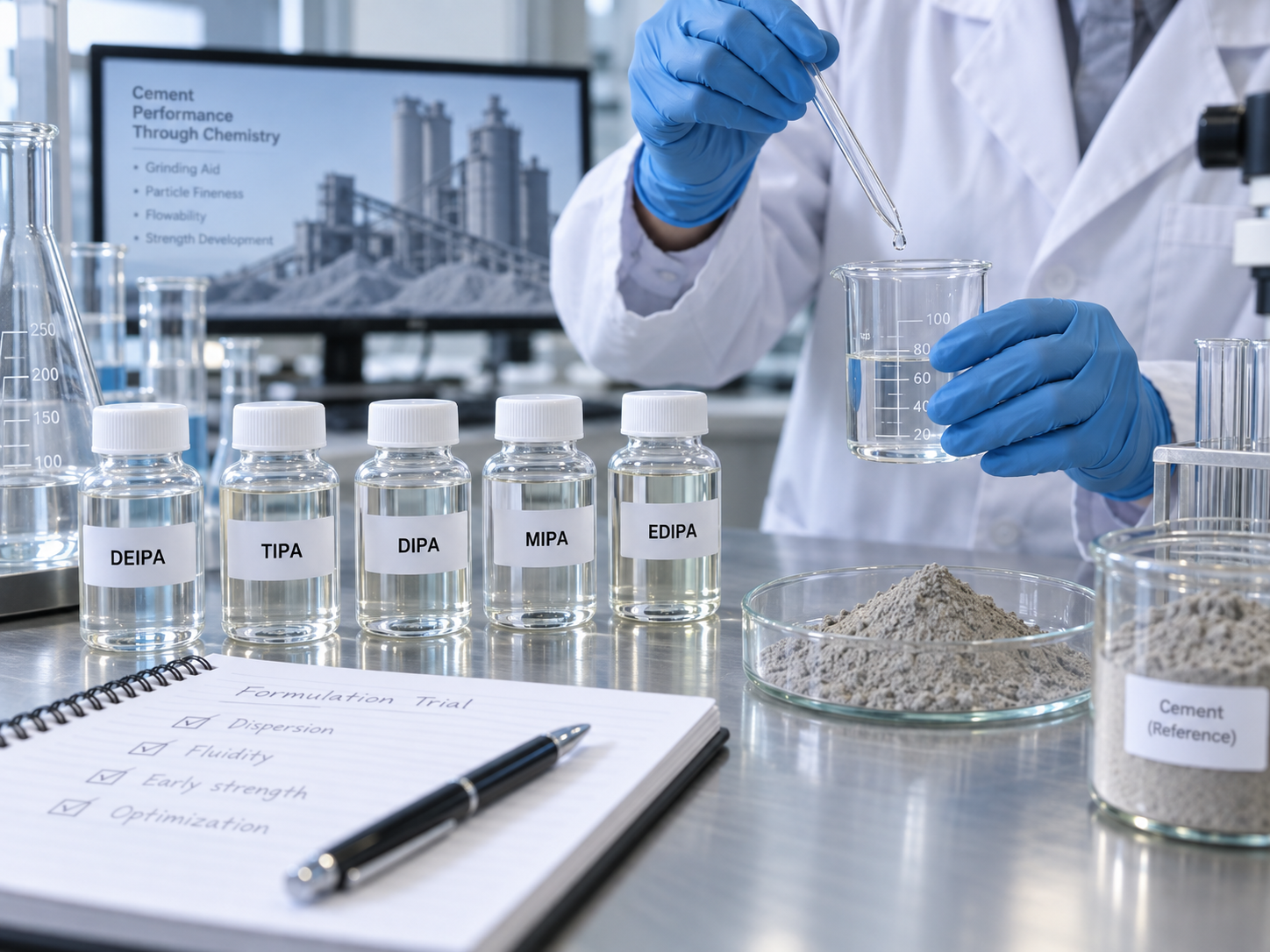
Grinding aid formulations are usually designed to improve grinding efficiency and support the overall production objective of the cement plant.
Depending on the formulation design, isopropanolamines may be selected as part of the grinding aid system because they can be used in formulations intended for:
However, actual formulation performance depends on the entire system, not on a single raw material alone.
That is why formulators usually evaluate isopropanolamines together with:
Some buyers start by asking:
“Should I choose DEIPA or TIPA?”
But in practice, supplier selection is more complex.
Even if two materials belong to the same category, the final result still depends on:
For this reason, product selection should be based on testing and application evaluation rather than product name alone.
DEIPA is one of the widely discussed isopropanolamine products in cement grinding aid development.
In the market, many grinding aid buyers evaluate DEIPA for use in applicable formulations related to cement production.
When assessing DEIPA, customers usually focus on:
For procurement, DEIPA should be evaluated in the actual grinding aid formula rather than only on paper specifications.
TIPA is also a commonly referenced raw material in grinding aid related discussions.
In some projects, customers may compare TIPA with DEIPA when reviewing raw material options for cement additives.
A practical comparison should not stop at theoretical differences.
Instead, formulators should compare how the product behaves in:
This type of controlled evaluation provides more useful information than relying only on general product descriptions.
Although DEIPA and TIPA often receive the most attention, other isopropanolamines may also be relevant depending on the formulation objective.
DIPA may be considered in selected formulations where the customer is evaluating alternative raw material structures.
MIPA may be of interest in certain industrial formulation studies and should be evaluated according to the target system.
EDIPA may also be considered as part of formulation development where specific compatibility or formulation requirements are being studied.
The key point is that these products should be tested based on the actual application target rather than selected only by category.
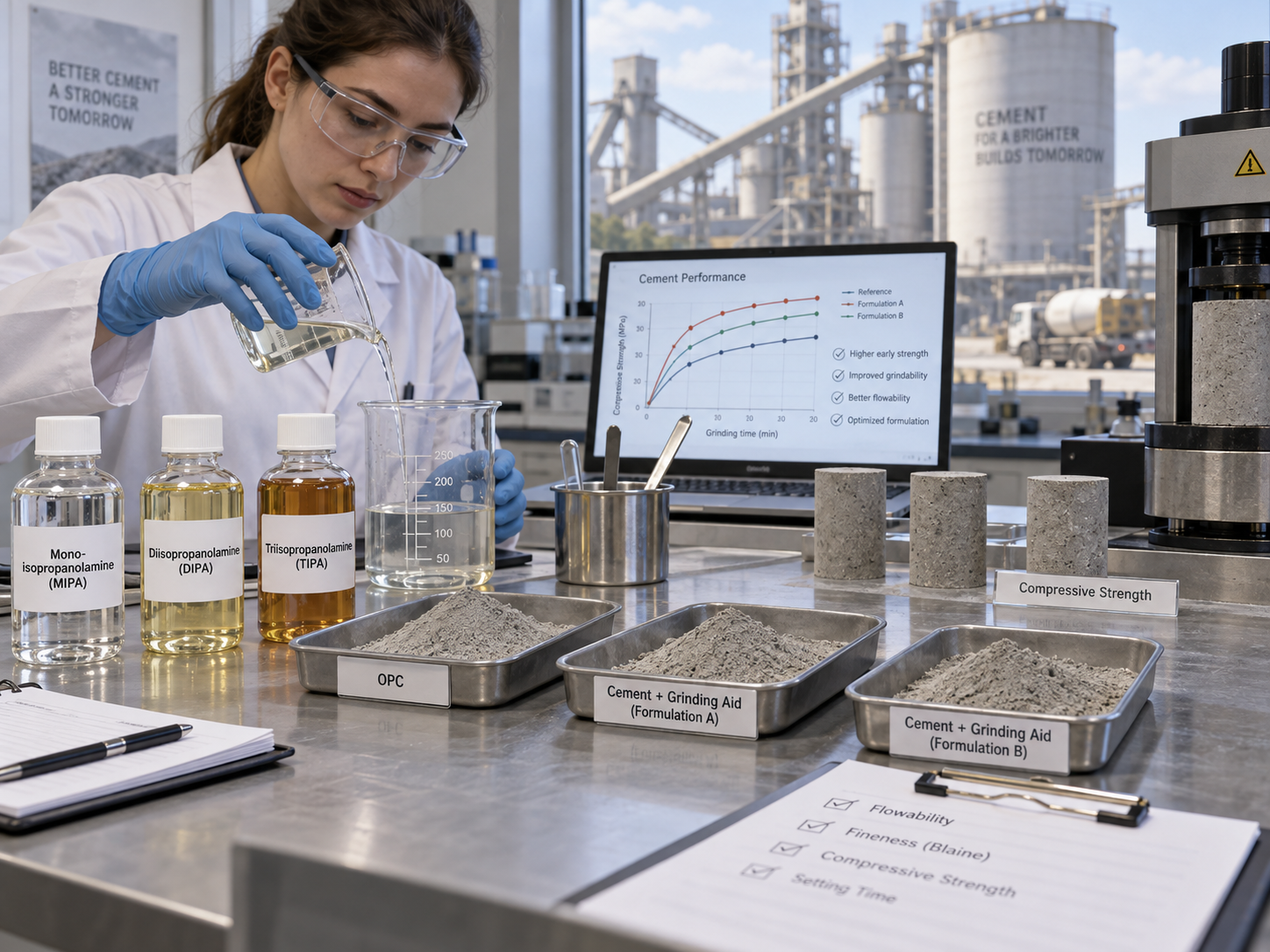
Before selecting an isopropanolamine, buyers should first clarify the formulation objective.
For example, the customer may want to develop or improve a grinding aid formulation for:
A clear objective helps define what kind of product comparison is meaningful.
Without that, even a good laboratory result may be difficult to interpret.
For chemical raw materials used in formulations, sample testing is usually an important step before regular purchasing.
A practical testing workflow may include:
This process helps reduce the risk of direct substitution without technical confirmation.
When replacing one isopropanolamine supplier with another, it is better to change only one major variable at a time.
For example, if a customer wants to compare a current DEIPA supply with a new DEIPA sample, it is better to keep the following unchanged:
This makes it easier to identify whether the observed difference comes from the new sample or from other changes in the system.
For export-oriented chemical purchasing, documentation is an important part of supplier evaluation.
Commonly required documents may include:
A professional supplier should be able to provide documentation according to the customer's procurement process.
Documentation is not only useful for customs and quality control, but also for internal purchasing approval.
Packaging and logistics are also important in international chemical trade.
Before placing an order, buyers usually need to confirm:
For regular commercial cooperation, delivery stability is often as important as price.
This is especially true when the raw material is used in continuous production.

A successful sample test is only the first step.
For long-term purchasing, the buyer should also consider whether the supplier can maintain stable commercial batches over time.
Stable supply helps reduce:
That is why supplier selection should include both sample performance and commercial supply reliability.
In raw material procurement, unit price is important, but it should not be the only factor.
A lower price may not always mean lower total cost if it leads to:
A more practical purchasing comparison includes:
To receive a more suitable offer, buyers can provide:
Clear information helps suppliers provide a more accurate quotation and more relevant technical support.
Commonly discussed products include DEIPA, TIPA, DIPA, MIPA and EDIPA.
Direct replacement without testing is not recommended. Actual suitability should be confirmed in the target formula and testing system.
Sample testing helps evaluate product compatibility with the current formula and reduces commercial purchasing risk.
Depending on the customer requirement, documents may include COA, TDS, SDS and standard commercial shipping documents.
Buyers usually review product quality, batch consistency, packaging, documentation, communication efficiency and delivery capability.
Selecting isopropanolamines for cement grinding aid formulations requires both technical evaluation and procurement judgment.
Instead of choosing a product only by name or price, buyers should evaluate:
For buyers working with DEIPA, TIPA, DIPA, MIPA or EDIPA, a reliable supplier should be able to provide stable product quality, technical documentation and export support according to purchasing requirements.
Shenyang Xingzhenghe Chemical Co., Ltd. supplies isopropanolamine products and related chemical raw materials for applicable industrial uses. Product documents, samples and packaging information can be provided according to customer requirements.
Contact Us
Email:sales01@xzhch.com
Phone:+86 138-8985-0231/+86 138-9812-5732
WeChat:+86 138-8985-0231/+86 138-9812-5732
Whatsapp:+86 138-8985-0231/+86 138-9812-5732
Address:No. 33, Naner Road, Heping District, Shenyang, Liaoning, China
Copyright © 2002-2025 Powered by EyouCms 备案号:辽ICP备12007065号-1